
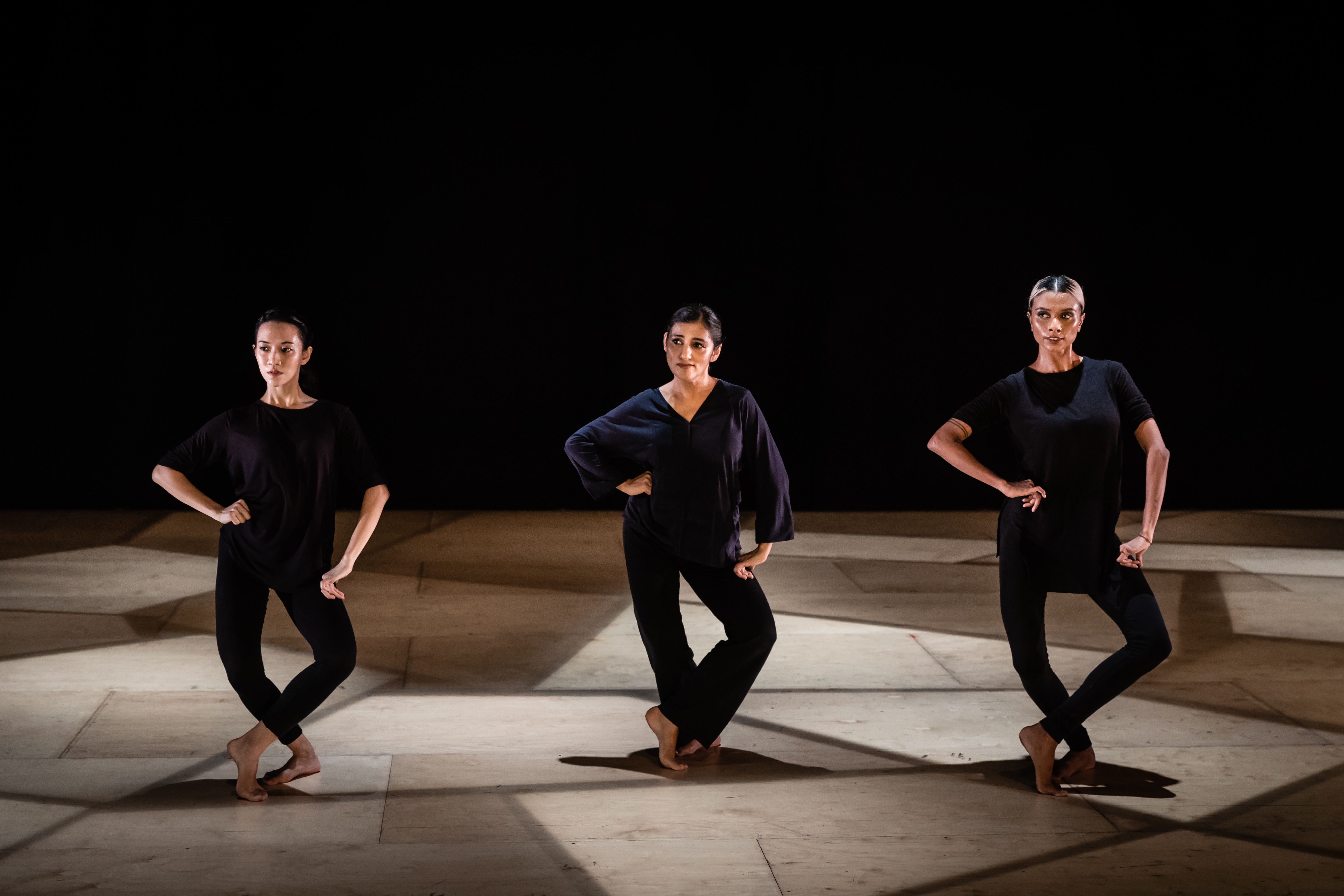
DAN 246: ODISSI Dance Technique I
Fall 2024
Monday/Wednesday 12:30-2:20pm
BAKER 1100
Professor Aparna Nambiar Office: Chambers 3286
Office Hrs: Wed 9am-10am, Thu: 1pm-2pm, and by appointment
Email: apnambiar@davidson.edu

COURSE SYLLABUS
COURSE DESCRIPTION
This Odissi technique class is a contemporary take on this ancient, eastern Indian dance form that links the body to non-western notions of time, space, rhythm and footwork. The class will cover the basic technique of Odissi dance—strong, stamping footwork, the sinuous torso, expressive gaze and symbolic hand gestures. Students will also learn the non-numeric time-keeping technique of Odissi training, using the voice.
The Odissi technique taught in this class brings together storytelling and strong physicality that draws from South Asian and Southeast Asian aesthetics. The politics of this form is embedded in its fluidity of the feminine and the masculine, the ancient and the modern, and the active and the passive. Students will learn to become slow and still, while remaining dynamic, powerful and activated. Students will also learn Odissi’s unique art of lyrical dancing, using the face, gestures and the body to become characters that can tell stories.
REQUIRED TEXTS
All texts and readings will be uploaded on Moodle.
LEARNING OBJECTIVES
-
Gain proficiency in foundational Odissi dance technique
-
Gain proficiency in the verbalization of the Odissi bols
-
Understand broad strokes of the history of Odissi, the religious and cultural worldview from which it stems, and the evolution of the contemporary practice of Odissi
-
Increase understanding that dance is shaped by cultural and historical contexts
-
Develop skills in critical viewing reading, writing and reflection skills- to be able to write about your experience learning Odissi while engaging with scholarly writings about the form
-
Develop awareness of and respect for cross-cultural differences
-
Engage in personal assessment and reflective practices that encourage self-directed learning
LEARNING OBJECTIVES ( SPECIFIC TO ODISSI DANCE TECHNIQUE)
-
Physical Foundations – To learn weight, balance and flexibility
-
Chowka technique steps 1-10
-
Tribhanga technique steps 1-10
-
Gestural Foundations - To speak the language of Odissi
-
Mudras – lexicon of 55 hand gestures
-
Listen – to the Odissi bols as auditory clips
-
Verbalize- be able to say the two basic non-linguistic verses we use to keep time in Odissi.
Note: Both Chowka and Tribhanga steps and the mudra series will be taught progressively and practiced over the course of the semester
COURSE REQUIREMENTS
*Attendance is essential to this class.
As a physical form, dance requires that you be present—both in body and mind. Students will be allowed a maximum of two absences for the semester; these will be granted with no questions asked. Each missed class—beyond the permitted—will lower your final grade by one letter grade (10 points). Students are responsible for all assignments given or due on days missed.
In case of injury, students must come to class and observe. This is also recommended in cases of non-contagious illness. Students will be required to submit notes on their observations for any classes in which they do not dance, but will not receive full participation credit for that day’s class. In cases of long-term illness or injury, please notify the instructor immediately so that an alternate course of study can be considered to fulfill the requirements of the class. If long-term illness or injury prevents a student from actively participating in class, the student may be advised to drop the course.
Two late arrivals (or early departures) will translate into one absence. If a student is late, he/she will be allowed to join the class at the discretion of the instructor. If a student arrives after roll is taken, it is his/her responsibility to make sure that the instructor has recorded his/her attendance.
*Participation is crucial to success in this course.
Full and consistent participation in every class is necessary. Students should come ready to dance at the start of every class meeting. Students are expected to continually demonstrate personal motivation and openness to the learning process; professional and mature behavior is required at all times. Students are expected to support each other in creating a safe space for experimentation with movement, creativity and expression.
*Informal Showing
While this course will not culminate in a formal performance, the class will present material at the end of the semester. This will be an informal showing of the technique we have learnt together. The choreographic material included in this showing will be completed in class; however, students will be expected to practice themselves outside of class.
In order to provide an audience for this event, each student will need to bring at least one guest to our final showing. They will need to sign in when they arrive and stay for the entire (albeit short) showing.
*Assessment of Progress
While I expect that every class (and every combination) will be treated like a performance, you will be asked to present the material we’ve been working on at the mid-point of the semester. In addition to this movement component, these assessments will also ask you to demonstrate knowledge of our repeated material in written form. The mid-semester assessment will occur during regularly scheduled class time. Another hand out will detail the expectations of this assessment.
*Self Evaluations
At both the midpoint and end of the semester, students will be asked to consider their progress and development in a written self-evaluation. A series of questions will be given to you to guide you in the writing of this personal reflection.
*Assignments
In addition to your participation, assessments and evaluations, you will have several written assignments for this course. It is expected that all of your written work will be thoroughly spell-checked, proofread and properly cited. All written assignments should be typed with standard fonts and formatting (1” margins, double spaced). Any papers/assignments submitted beyond the due date will be docked one letter grade (10 points) for each day that they are late.
Course Readings and Spoken Discussions: Throughout the semester, students will be assigned writings by scholars and historians of Odissi and related forms of dance. These writings will provide students with deeper understanding of the philosophies and figures that have shaped the development of the art form.
Spoken Discussions: For each set of readings, students will be required to come prepared with three points of interest that critically engage with the ideas presented. In class, the professor will ask you to describe three areas of interest, taken from different segments of each reading. You will identify 1) what your point of interest is, 2) what your current understanding of this term is, 3) what you do not understand and 4) something you can relate to about this. Further, be prepared for short discussions of the readings on the day of submission.
Journal: Maintain a Journal containing sketches, writing reflections, images, video and audio files. Feel free to choose either analogue or digital formats or hybrid formats. This journal is a document that you will present to the class as part of your mid-semester and final self-evaluations.
Digital journals: Maybe on any platform can be used, with the caveat that you should be able to upload images of your own hand-made drawings or hand-written brainstorms. You can use google docs, notes app, notion, canva, Pinterest, anything. The Instructor and your peers-in-class must be given access. Public access to those outside of the class without prior permissions. These materials should not be made public as part of your personal social media platforms.
Analogue journals: Actual notebooks/ sketchbooks/ scrapbooks. You can also contain images that you download and print off of the internet, or, you could try to sketch images that you see. For audio and video links in the analogue format, you can submit links to me via email with the subject title “JOURNAL” or use your computer as a visual aid during your mid-semester and final evaluations. You can also include other materials to collate inspiration and information about the dance forms - including textile, objects, memorabilia, flowers and leaves, incense, candles, etc.
Course Screenings: At regular intervals throughout the semester, students will be asked to screen videos or online clips of South Asian dance performances and/or documentaries on modern (Odissi) dance artists. The videos will be made available on reserve in the library; links to the online clips can be accessed through Moodle. On assigned days, students should be prepared—at the start of class—to discuss what they have screened.
Final Paper: Drawing on the readings and class experiences, students will write a three-five page paper that addresses issues raised throughout the semester. While additional research will not be required, some students may decide to investigate a specific choreographer and/or style in more depth to inform their final writing. Specific details of this assignment will be outlined in another document.
COURSE POLICIES
*Class Preparation and Conduct
Clothing
Students are required to wear clothing suitable for unrestricted movement. Unlike Western Ballet, Modern or Contemporary dance classes, Odissi can be done in baggy cotton or linen pants and tops – not only are leotards not expected, they are not preferred. You can wear a tank or t-shirt and any kind of non-denim cotton pants that you can dance in, or the kind of workout clothes that can wick sweat. No dresses, skirts or shorts and all pants must be below the knees—nothing shorter than mid-way of your calves/shins.
South Asian Dance technique is usually practiced in short saris that hit above the ankle or long cotton or linen tunics (kurtas and long cotton or linen (salwar or chudidhar bottoms/ leggings). I will be bearing cotton/linen tops and pants; sometimes, the sari- you don’t need to buy these. You can choose to wear anything that fits in the above options. Hair must be tied back and away from the face.
Jewelry – necklaces, bangles, anklets– are absolutely welcome, as long as it doesn’t impede movement or cause physical discomfort. Students are required to dance in bare feet; as South Asian Dance requires hard stamping, this form cannot be done in socks. Shoes of any kind are not allowed on the dance floor.
Only bottled water is permitted in the studio; please bring it with you, if you will want it during the course of the class. Absolutely no gum chewing is allowed. Cell phones must be OFF for the duration of the class.
*Accommodations for Students with Disabilities
The college welcomes requests for accommodations related to disability and will grant those that are determined to be reasonable and maintain the integrity of a program or curriculum. To make such a request or to begin a conversation about a possible request, please contact the Office of Academic Access and Disability Resources by emailing AADR@davidson.edu. It is best to submit accommodation requests within the drop/add period; however, requests can be made at any time in the semester. Please keep in mind that accommodations are not retroactive
Additionally, Academic Access and Disability Resources offers free academic coaching services to students. If you need help with time management, test taking, studying efficiently, or other academic strategies, a professional staff academic coach or peer academic coach can meet with you once or on an as needed basis. Contact AADR@davidson.edu for more information. Please also stay tuned for Peer Academic Coaching events throughout the semester.
*Plagiarism and Generative AI Use:
All work submitted in this course must be your own. Contributions from anyone or anything else- including AI sources, must be properly quoted and cited every time they are used. Generative AI can be a wonderful aid to your learning, but the point of education is for your own, biological neural networks to be forged and intensified, not that of Meta’s or Alphabet’s or Open AI’s. Failure to properly cite your sources or presenting work generated by AI as your own constitués an academic integrity violation, and I will follow the institution’s policy to the letter in those instances.
*Offensive Material
Contemporary modern dance performances- South Asian, Western or otherwise, often attempt to reflect and reframe issues of contemporary life. As a result, the dance works that we will look at sometimes contain graphic imagery, nudity and/or potentially offensive language. I will assume that each student is comfortable viewing and discussing such material. If you are not, please come to see me outside of class and I will do my best to address your concerns with sensitivity.
*Davidson’s Honor Code:
Each student is expected to be familiar with and abide by the Honor Code, which is fully supported and endorsed by this department and the instructor.
*Evaluation
Grades will be calculated as follows:
Participation 30%
Short Assignments (4) 20%
Final Paper 15%
Midterm Self Evaluation of Journal: 5%
Midterm Assessment of Progress: 10%
Final Self Evaluation of journal: 5%
Informal Showing: 15%
Grading Scale
A =94 and above
A-=90-93
B+=87-89
B =84-86
B- =80-83
C+=77-79
C =74-76
C- =70-73
D =60-69
F =59 and below
You may meet with the instructor at any time to discuss your progress and grade.
COURSE SCHEDULE/IMPORTANT DATES
*Readings are due on the day they are listed. Readings and or dates may be changed at the discretion of the instructor. Readings will be uploaded on the Moodle site, unless otherwise instructed at a later date by the professor.
WEEK 1
Mon Aug 26: Watch in-class: Arushi Mudgal Performance Clip NYC
Wed Aug 28: Read: Alastair Macaulay: Review: The Profound Eloquence
of Odissi Dance - The New York Times
WEEK 2
Mon Sep 2: Read: Chapter 1 Sikand, Nandini.
“Chapter 1: (Re)writing a History of Odissi Dance” Languid Bodies, Grounded Stances: The Curving Pathway of Neoclassical Odissi Dance. Vol. 9. Berghahn Books, 2016. [READ UP TO PAGE 46, notes inclusive]
Wed Sep 4: Watch: https://www.youtube.com/watch?v=EM_VrWQNpBI
In Class: Visualizing through the body on paper
WEEK 3
Mon Sep 9: Read: Chapter 1 Sikand, Nandini.
“Chapter 1: (Re)writing a History of Odissi Dance” Languid Bodies, Grounded Stances: The Curving Pathway of Neoclassical Odissi Dance. Vol. 9. Berghahn Books, 2016. [READ UP TO PAGE PAGE 47-68, notes inclusive]
Due Sep 9: Short Assignment 1:Self- Introduction video. + Make sure you have selected your Journal, in whatever format and bring it to class.
Wed Sep 11: In-Class Journaling time
WEEK 4
Mon Sep 16: Read : Chatterjea, Ananya. “Why I am committed to a South
Asian Dance Aesthetic” Traversing Tradition : Celebrating Dance in India, edited by Urmimala Sarkar Munsi, and Stephanie Burridge, Taylor & Francis Group, 2011.
Due Sep 16: Short Assignment 2: Researching of five unfamiliar terms from Sikand, Nandini
Wed Sep 18: In-Class Journalling
WEEK 5
Mon Sep 23: Read page 20-24 and observe images on pages 40-41 in Banerji, Anurima. “Dancing Odissi: Paratopic Performances of Gender”. University of Chicago Press, 2019
Wed Sep 25: In-Class: Journaling time
WEEK 6
Mon Sep 30 : Read: Alastair Macaulay “Visions of India, Plum Fairies And
Watch: In Conversation with Madhavi Mudgal (Part 1): Forms in Space | Sahapedia
Wed Oct 2: In-Class Workshop: For Final Writing Assignment
WEEK 7
Mon Oct 7: Read page 43-59 Banerji, Anurima. Dancing Odissi: Paratopic
Performances of Gender and State. University of Chicago Press, 2019
Wed Oct 9: Mid semester Evaluation- Journal
WEEK 8
Mon Oct 14 Read: Schechner, R., Zarrilli, P., Panigrahi, S., Mahapatra, K., &
Panigrahi, R. (1988). Collaborating on Odissi: An Interview with Sanjukta Panigrahi, Kelucharan Mahapatra, and Raghunath Panigrahi. TDR : Drama Review, 32(1), 128–138. https://doi.org/10.2307/1145874
Wed Oct 16 In-Class Journaling
WEEK 9
Mon Oct 21: Read: Selections from: The Natyashasthra (TBC)
Due Oct 21: Short Assignment 3. 2-page essay Connecting your experience Dancing Odissi with any 2 readings assigned so far.
Wed Oct 23: Read: Selections from DN Patnaik’s Odissi (TBC)
WEEK 10
Mon Oct 28: Read: Banerji, A. (2021). The Laws of Movement: The
Natyashastra as Archive for Indian Classical Dance. Contemporary Theatre Review, 31(1–2), 132–152.
Wed Oct 30: Prof. Nambiar Away for South Asia Studies Conference
Asynchronous Exercise:
Watch:Mangalacharanam Odissi dance by Madhavi Mudgal
Write: Auto-ethnographic Essay: three three stances from the video that you are familiar with, with time stamps. Write a 2-page essay describe these stances in relation to your experience of practicing the same. Submit on Moodle by Monday, Nov 4 2024.
WEEK 11
Mon Nov 4: Read: Anurima Bannerji “Extraordinary Gender Performance:
Queer Bodies in South Asian Dance” in Dancing Odissi: Paratopic Performances of Gender and State. University of Chicago Press, 2019
Due on Mon Nov 4: Short Assignment 4. 2-page Auto-ethnographic Essay
Wed Nov 6 In-class Journaling Exercise
WEEK 12
Mon Nov 11 Read: Nambiar, A. R. (2021). The Aesthetic of Acclimatization.
Performance Research, 26(6), 45–53.
IN-CLASS SCREENING OF EXCERPTS FROM “PALLAVI IN TIME” and January Low
Wed Nov 13 : In-class journalling/ prep for final paper.
WEEK 13
Mon Nov 18: Read: Banerji, Anurima. "4 Nrityagram." How To Do
Politics With Art4 (2016): 88.
Read: An Odissi Dancer Charts New Paths at the Met Museum - The New York Times
Wed Nov 20: Watch: In-class journalling/ prep for final paper.
WEEK 14
Thanksgiving break
WEEK 15
Mon Dec 2: TBA
Wed Dec 4: TBA
Week 16
DAN 246: ODISSI Dance Technique I
Fall 2024
Monday/Wednesday 12:30-2:20pm
BAKER 1100
Professor Aparna Nambiar Office: Chambers 3286
Office Hrs: Wed 9am-10am, Thu: 1pm-2pm, and by appointment
Email: apnambiar@davidson.edu
COURSE SYLLABUS
COURSE DESCRIPTION
This Odissi technique class is a contemporary take on this ancient, eastern Indian dance form that links the body to non-western notions of time, space, rhythm and footwork. The class will cover the basic technique of Odissi dance—strong, stamping footwork, the sinuous torso, expressive gaze and symbolic hand gestures. Students will also learn the non-numeric time-keeping technique of Odissi training, using the voice.
The Odissi technique taught in this class brings together storytelling and strong physicality that draws from South Asian and Southeast Asian aesthetics. The politics of this form is embedded in its fluidity of the feminine and the masculine, the ancient and the modern, and the active and the passive. Students will learn to become slow and still, while remaining dynamic, powerful and activated. Students will also learn Odissi’s unique art of lyrical dancing, using the face, gestures and the body to become characters that can tell stories.
REQUIRED TEXTS
All texts and readings will be uploaded on Moodle.
LEARNING OBJECTIVES
-
Gain proficiency in foundational Odissi dance technique
-
Gain proficiency in the verbalization of the Odissi bols
-
Understand broad strokes of the history of Odissi, the religious and cultural worldview from which it stems, and the evolution of the contemporary practice of Odissi
-
Increase understanding that dance is shaped by cultural and historical contexts
-
Develop skills in critical viewing reading, writing and reflection skills- to be able to write about your experience learning Odissi while engaging with scholarly writings about the form
-
Develop awareness of and respect for cross-cultural differences
-
Engage in personal assessment and reflective practices that encourage self-directed learning
LEARNING OBJECTIVES ( SPECIFIC TO ODISSI DANCE TECHNIQUE)
-
Physical Foundations – To learn weight, balance and flexibility
-
Chowka technique steps 1-10
-
Tribhanga technique steps 1-10
-
Gestural Foundations - To speak the language of Odissi
-
Mudras – lexicon of 55 hand gestures
-
Listen – to the Odissi bols as auditory clips
-
Verbalize- be able to say the two basic non-linguistic verses we use to keep time in Odissi.
Note: Both Chowka and Tribhanga steps and the mudra series will be taught progressively and practiced over the course of the semester
COURSE REQUIREMENTS
*Attendance is essential to this class.
As a physical form, dance requires that you be present—both in body and mind. Students will be allowed a maximum of two absences for the semester; these will be granted with no questions asked. Each missed class—beyond the permitted—will lower your final grade by one letter grade (10 points). Students are responsible for all assignments given or due on days missed.
In case of injury, students must come to class and observe. This is also recommended in cases of non-contagious illness. Students will be required to submit notes on their observations for any classes in which they do not dance, but will not receive full participation credit for that day’s class. In cases of long-term illness or injury, please notify the instructor immediately so that an alternate course of study can be considered to fulfill the requirements of the class. If long-term illness or injury prevents a student from actively participating in class, the student may be advised to drop the course.
Two late arrivals (or early departures) will translate into one absence. If a student is late, he/she will be allowed to join the class at the discretion of the instructor. If a student arrives after roll is taken, it is his/her responsibility to make sure that the instructor has recorded his/her attendance.
*Participation is crucial to success in this course.
Full and consistent participation in every class is necessary. Students should come ready to dance at the start of every class meeting. Students are expected to continually demonstrate personal motivation and openness to the learning process; professional and mature behavior is required at all times. Students are expected to support each other in creating a safe space for experimentation with movement, creativity and expression.
*Informal Showing
While this course will not culminate in a formal performance, the class will present material at the end of the semester. This will be an informal showing of the technique we have learnt together. The choreographic material included in this showing will be completed in class; however, students will be expected to practice themselves outside of class.
In order to provide an audience for this event, each student will need to bring at least one guest to our final showing. They will need to sign in when they arrive and stay for the entire (albeit short) showing.
*Assessment of Progress
While I expect that every class (and every combination) will be treated like a performance, you will be asked to present the material we’ve been working on at the mid-point of the semester. In addition to this movement component, these assessments will also ask you to demonstrate knowledge of our repeated material in written form. The mid-semester assessment will occur during regularly scheduled class time. Another hand out will detail the expectations of this assessment.
*Self Evaluations
At both the midpoint and end of the semester, students will be asked to consider their progress and development in a written self-evaluation. A series of questions will be given to you to guide you in the writing of this personal reflection.
*Assignments
In addition to your participation, assessments and evaluations, you will have several written assignments for this course. It is expected that all of your written work will be thoroughly spell-checked, proofread and properly cited. All written assignments should be typed with standard fonts and formatting (1” margins, double spaced). Any papers/assignments submitted beyond the due date will be docked one letter grade (10 points) for each day that they are late.
Course Readings and Spoken Discussions: Throughout the semester, students will be assigned writings by scholars and historians of Odissi and related forms of dance. These writings will provide students with deeper understanding of the philosophies and figures that have shaped the development of the art form.
Spoken Discussions: For each set of readings, students will be required to come prepared with three points of interest that critically engage with the ideas presented. In class, the professor will ask you to describe three areas of interest, taken from different segments of each reading. You will identify 1) what your point of interest is, 2) what your current understanding of this term is, 3) what you do not understand and 4) something you can relate to about this. Further, be prepared for short discussions of the readings on the day of submission.
Journal: Maintain a Journal containing sketches, writing reflections, images, video and audio files. Feel free to choose either analogue or digital formats or hybrid formats. This journal is a document that you will present to the class as part of your mid-semester and final self-evaluations.
Digital journals: Maybe on any platform can be used, with the caveat that you should be able to upload images of your own hand-made drawings or hand-written brainstorms. You can use google docs, notes app, notion, canva, Pinterest, anything. The Instructor and your peers-in-class must be given access. Public access to those outside of the class without prior permissions. These materials should not be made public as part of your personal social media platforms.
Analogue journals: Actual notebooks/ sketchbooks/ scrapbooks. You can also contain images that you download and print off of the internet, or, you could try to sketch images that you see. For audio and video links in the analogue format, you can submit links to me via email with the subject title “JOURNAL” or use your computer as a visual aid during your mid-semester and final evaluations. You can also include other materials to collate inspiration and information about the dance forms - including textile, objects, memorabilia, flowers and leaves, incense, candles, etc.
Course Screenings: At regular intervals throughout the semester, students will be asked to screen videos or online clips of South Asian dance performances and/or documentaries on modern (Odissi) dance artists. The videos will be made available on reserve in the library; links to the online clips can be accessed through Moodle. On assigned days, students should be prepared—at the start of class—to discuss what they have screened.
Final Paper: Drawing on the readings and class experiences, students will write a three-five page paper that addresses issues raised throughout the semester. While additional research will not be required, some students may decide to investigate a specific choreographer and/or style in more depth to inform their final writing. Specific details of this assignment will be outlined in another document.
COURSE POLICIES
*Class Preparation and Conduct
Clothing
Students are required to wear clothing suitable for unrestricted movement. Unlike Western Ballet, Modern or Contemporary dance classes, Odissi can be done in baggy cotton or linen pants and tops – not only are leotards not expected, they are not preferred. You can wear a tank or t-shirt and any kind of non-denim cotton pants that you can dance in, or the kind of workout clothes that can wick sweat. No dresses, skirts or shorts and all pants must be below the knees—nothing shorter than mid-way of your calves/shins.
South Asian Dance technique is usually practiced in short saris that hit above the ankle or long cotton or linen tunics (kurtas and long cotton or linen (salwar or chudidhar bottoms/ leggings). I will be bearing cotton/linen tops and pants; sometimes, the sari- you don’t need to buy these. You can choose to wear anything that fits in the above options. Hair must be tied back and away from the face.
Jewelry – necklaces, bangles, anklets– are absolutely welcome, as long as it doesn’t impede movement or cause physical discomfort. Students are required to dance in bare feet; as South Asian Dance requires hard stamping, this form cannot be done in socks. Shoes of any kind are not allowed on the dance floor.
Only bottled water is permitted in the studio; please bring it with you, if you will want it during the course of the class. Absolutely no gum chewing is allowed. Cell phones must be OFF for the duration of the class.
*Accommodations for Students with Disabilities
The college welcomes requests for accommodations related to disability and will grant those that are determined to be reasonable and maintain the integrity of a program or curriculum. To make such a request or to begin a conversation about a possible request, please contact the Office of Academic Access and Disability Resources by emailing AADR@davidson.edu. It is best to submit accommodation requests within the drop/add period; however, requests can be made at any time in the semester. Please keep in mind that accommodations are not retroactive
Additionally, Academic Access and Disability Resources offers free academic coaching services to students. If you need help with time management, test taking, studying efficiently, or other academic strategies, a professional staff academic coach or peer academic coach can meet with you once or on an as needed basis. Contact AADR@davidson.edu for more information. Please also stay tuned for Peer Academic Coaching events throughout the semester.
*Plagiarism and Generative AI Use:
All work submitted in this course must be your own. Contributions from anyone or anything else- including AI sources, must be properly quoted and cited every time they are used. Generative AI can be a wonderful aid to your learning, but the point of education is for your own, biological neural networks to be forged and intensified, not that of Meta’s or Alphabet’s or Open AI’s. Failure to properly cite your sources or presenting work generated by AI as your own constitués an academic integrity violation, and I will follow the institution’s policy to the letter in those instances.
*Offensive Material
Contemporary modern dance performances- South Asian, Western or otherwise, often attempt to reflect and reframe issues of contemporary life. As a result, the dance works that we will look at sometimes contain graphic imagery, nudity and/or potentially offensive language. I will assume that each student is comfortable viewing and discussing such material. If you are not, please come to see me outside of class and I will do my best to address your concerns with sensitivity.
*Davidson’s Honor Code:
Each student is expected to be familiar with and abide by the Honor Code, which is fully supported and endorsed by this department and the instructor.
*Evaluation
Grades will be calculated as follows:
Participation 30%
Short Assignments (4) 20%
Final Paper 15%
Midterm Self Evaluation of Journal: 5%
Midterm Assessment of Progress: 10%
Final Self Evaluation of journal: 5%
Informal Showing: 15%
Grading Scale
A =94 and above
A-=90-93
B+=87-89
B =84-86
B- =80-83
C+=77-79
C =74-76
C- =70-73
D =60-69
F =59 and below
You may meet with the instructor at any time to discuss your progress and grade.
COURSE SCHEDULE/IMPORTANT DATES
*Readings are due on the day they are listed. Readings and or dates may be changed at the discretion of the instructor. Readings will be uploaded on the Moodle site, unless otherwise instructed at a later date by the professor.
WEEK 1
Mon Aug 26: Watch in-class: Arushi Mudgal Performance Clip NYC
Wed Aug 28: Read: Alastair Macaulay: Review: The Profound Eloquence
of Odissi Dance - The New York Times
WEEK 2
Mon Sep 2: Read: Chapter 1 Sikand, Nandini.
“Chapter 1: (Re)writing a History of Odissi Dance” Languid Bodies, Grounded Stances: The Curving Pathway of Neoclassical Odissi Dance. Vol. 9. Berghahn Books, 2016. [READ UP TO PAGE 46, notes inclusive]
Wed Sep 4: Watch: https://www.youtube.com/watch?v=EM_VrWQNpBI
In Class: Visualizing through the body on paper
WEEK 3
Mon Sep 9: Read: Chapter 1 Sikand, Nandini.
“Chapter 1: (Re)writing a History of Odissi Dance” Languid Bodies, Grounded Stances: The Curving Pathway of Neoclassical Odissi Dance. Vol. 9. Berghahn Books, 2016. [READ UP TO PAGE PAGE 47-68, notes inclusive]
Due Sep 9: Short Assignment 1:Self- Introduction video. + Make sure you have selected your Journal, in whatever format and bring it to class.
Wed Sep 11: In-Class Journaling time
WEEK 4
Mon Sep 16: Read : Chatterjea, Ananya. “Why I am committed to a South
Asian Dance Aesthetic” Traversing Tradition : Celebrating Dance in India, edited by Urmimala Sarkar Munsi, and Stephanie Burridge, Taylor & Francis Group, 2011.
Due Sep 16: Short Assignment 2: Researching of five unfamiliar terms from Sikand, Nandini
Wed Sep 18: In-Class Journalling
WEEK 5
Mon Sep 23: Read page 20-24 and observe images on pages 40-41 in Banerji, Anurima. “Dancing Odissi: Paratopic Performances of Gender”. University of Chicago Press, 2019
Wed Sep 25: In-Class: Journaling time
WEEK 6
Mon Sep 30 : Read: Alastair Macaulay “Visions of India, Plum Fairies And
Watch: In Conversation with Madhavi Mudgal (Part 1): Forms in Space | Sahapedia
Wed Oct 2: In-Class Workshop: For Final Writing Assignment
WEEK 7
Mon Oct 7: Read page 43-59 Banerji, Anurima. Dancing Odissi: Paratopic
Performances of Gender and State. University of Chicago Press, 2019
Wed Oct 9: Mid semester Evaluation- Journal
WEEK 8
Mon Oct 14 Read: Schechner, R., Zarrilli, P., Panigrahi, S., Mahapatra, K., &
Panigrahi, R. (1988). Collaborating on Odissi: An Interview with Sanjukta Panigrahi, Kelucharan Mahapatra, and Raghunath Panigrahi. TDR : Drama Review, 32(1), 128–138. https://doi.org/10.2307/1145874
Wed Oct 16 In-Class Journaling
WEEK 9
Mon Oct 21: Read: Selections from: The Natyashasthra (TBC)
Due Oct 21: Short Assignment 3. 2-page essay Connecting your experience Dancing Odissi with any 2 readings assigned so far.
Wed Oct 23: Read: Selections from DN Patnaik’s Odissi (TBC)
WEEK 10
Mon Oct 28: Read: Banerji, A. (2021). The Laws of Movement: The
Natyashastra as Archive for Indian Classical Dance. Contemporary Theatre Review, 31(1–2), 132–152.
Wed Oct 30: Prof. Nambiar Away for South Asia Studies Conference
Asynchronous Exercise:
Watch:Mangalacharanam Odissi dance by Madhavi Mudgal
Write: Auto-ethnographic Essay: three three stances from the video that you are familiar with, with time stamps. Write a 2-page essay describe these stances in relation to your experience of practicing the same. Submit on Moodle by Monday, Nov 4 2024.
WEEK 11
Mon Nov 4: Read: Anurima Bannerji “Extraordinary Gender Performance:
Queer Bodies in South Asian Dance” in Dancing Odissi: Paratopic Performances of Gender and State. University of Chicago Press, 2019
Due on Mon Nov 4: Short Assignment 4. 2-page Auto-ethnographic Essay
Wed Nov 6 In-class Journaling Exercise
WEEK 12
Mon Nov 11 Read: Nambiar, A. R. (2021). The Aesthetic of Acclimatization.
Performance Research, 26(6), 45–53.
IN-CLASS SCREENING OF EXCERPTS FROM “PALLAVI IN TIME” and January Low
Wed Nov 13 : In-class journalling/ prep for final paper.
WEEK 13
Mon Nov 18: Read: Banerji, Anurima. "4 Nrityagram." How To Do
Politics With Art4 (2016): 88.
Read: An Odissi Dancer Charts New Paths at the Met Museum - The New York Times
Wed Nov 20: Watch: In-class journalling/ prep for final paper.
WEEK 14
Thanksgiving break
WEEK 15
Mon Dec 2: TBA
Wed Dec 4: TBA
Week 16
Mon Dec 9: Due: Final Self-Evaluation
Wed Dec 11 : Due: Informal Showing
Mon Dec 16th: Final Paper Due
Mon Dec 9: Due: Final Self-Evaluation
Wed Dec 11 : Due: Informal Showing
Mon Dec 16th: Final Paper Due